

Fast Fire Gear · Home & Family Guide
Sundström Masks for Your Home & Family
Smoke and ash linger long after the flames. The Sundström Wildland First Responder Kit is a reusable, NIOSH-approved P100 respirator built for fire country, and it is just as useful in your garage go-bag as it is on a fire line.
Why it matters
Wildfire smoke is more than a bad smell
Smoke and ash can irritate your eyes, nose, throat and lungs, make you cough or wheeze, and make it hard to breathe. The U.S. EPA says the best protection is to limit time outdoors when the air is smoky. When you do have to be outside, or you are cleaning up ash, a properly fitted NIOSH-approved N95 or P100 respirator can help protect your lungs.
During a smoke event
Get through smoky days
Check the AirNow Fire and Smoke Map, stay inside with clean air when you can, and wear the mask when you have to go out: feeding animals, checking the property, running errands.
After the fire
Clean up ash safely
Ash and debris can hold harmful residue. Wear a sealed P100 respirator, gloves, long sleeves and long pants. Mist ash before sweeping and use a HEPA vacuum, never a leaf blower or shop vac.
Be ready
One kit per adult
Smoke arrives fast. Keep a fitted, labeled kit for each adult and teen in the house, next to your go-bag and the car keys, so nobody is sharing or searching when the sky turns orange.
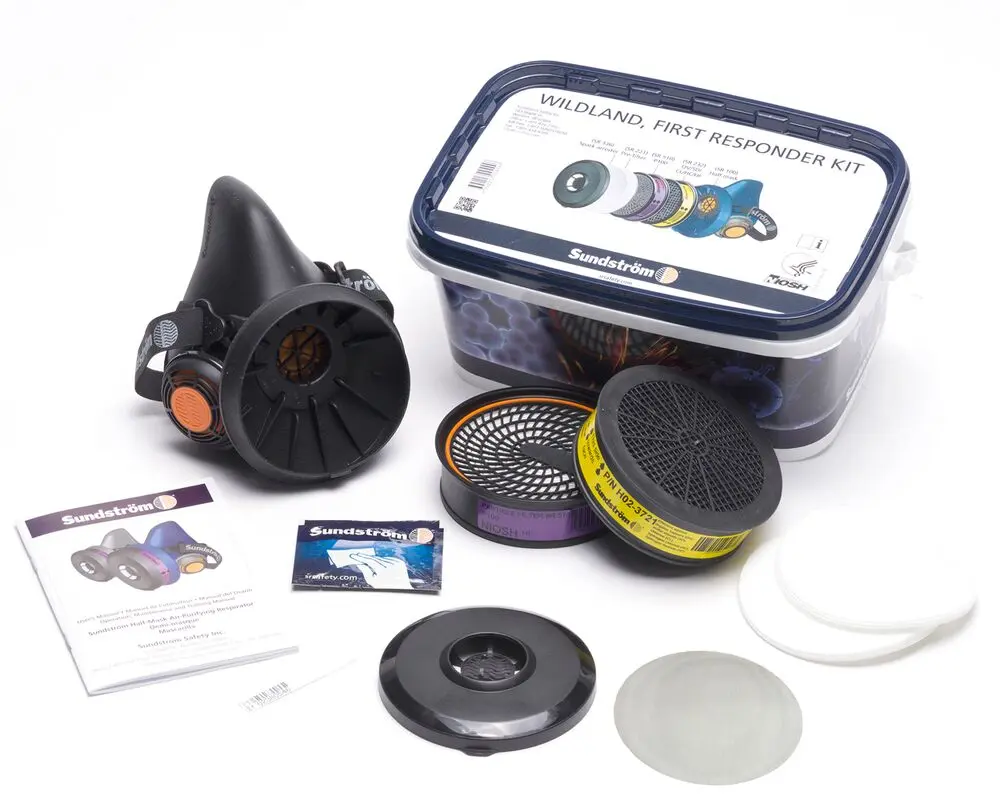
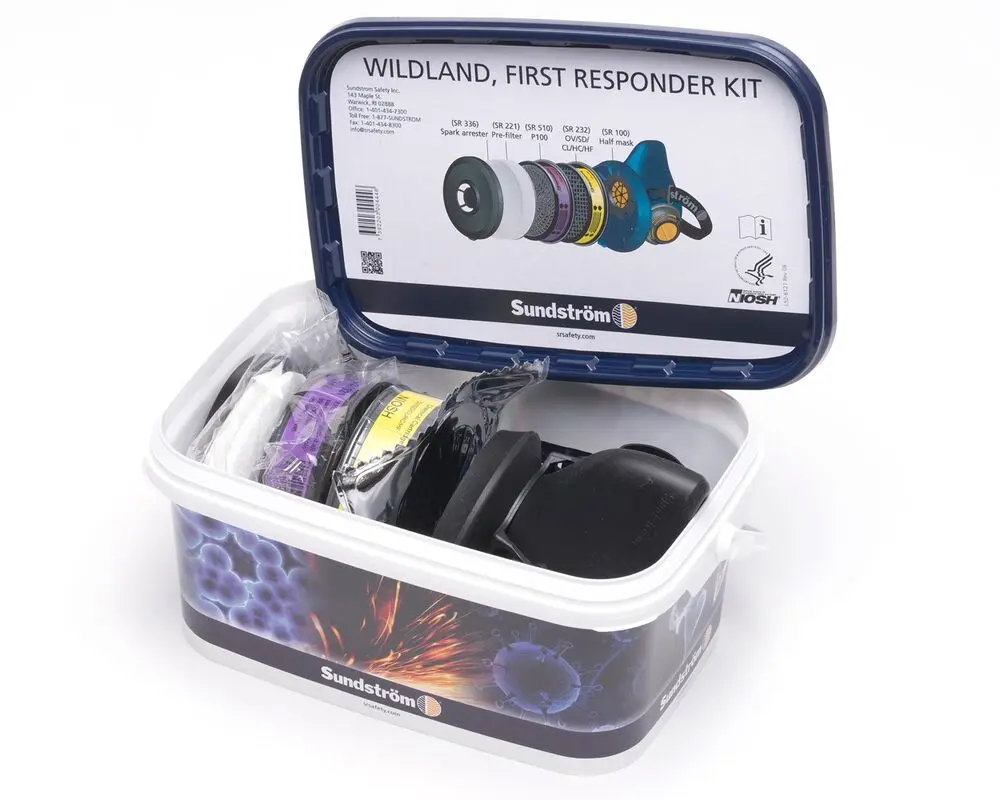
What’s in the box
Everything you need, in one storage tub
Each Sundström Wildland First Responder Kit (made in Sweden) includes:
- SR 100 silicone half mask in the size you choose
- SR 510 P100 particulate filter (1)
- SR 232 gas cartridge for certain organic vapors and acid gases (1)
- SR 221 pre-filters (10)
- Pre-filter holder, which is also used for your seal check
- SR 336 spark arrester, a stainless steel mesh disc that shields the filters
- SR 5226 cleaning wipe and SR 368 ID tag
- Storage box
Reusable P100 vs. disposable masks
Why step up from a paper N95?
A NIOSH-approved N95 is a good start, and the EPA recommends both N95 and P100 respirators for smoke and ash. Here’s why a reusable P100 is worth keeping on hand:
Filtration
99.97% vs. 95%
A NIOSH P100 filter must capture at least 99.97% of particles in testing, and an N95 at least 95%. Sundström reports that its SR 510 tests above 99.997%. The “P” also means the filter is oil-proof.
Seal
Soft silicone, adjustable harness
The SR 100 is molded from silicone approved by the FDA and BGA for food contact, which lowers the risk of skin allergies. A V-shaped elastic harness and large crown plate hold it snugly against your face.
Breathing and value
Two exhale valves, swap the filters
Two exhalation valves keep exhaling easy. Keep the mask and replace only the filter: $13.95 each, or $62.95 for a 5-pack. Clip-in pre-filters catch coarse ash first, so the P100 lasts longer.
Specifications
The facts, straight from Sundström
| Item | Details |
|---|---|
| Kit part numbers | H05-6121S (S/M) · H05-6121M (M/L) · H05-6121L (L/XL) |
| Mask | SR 100 half mask, silicone, two exhalation valves, approx. 5.7–6.2 oz (162–176 g) |
| Particulate filter | SR 510 P100/HE (magenta label), tested to >99.997% (NIOSH minimum 99.97%) |
| Gas cartridge | SR 232 (yellow label): organic vapor, sulfur dioxide, chlorine, hydrogen chloride and hydrogen fluoride (OV/SD/CL/HC/HF) |
| Approval | NIOSH-approved under 42 CFR Part 84 |
| Assigned protection factor | 10 (the OSHA value for all half-mask air-purifying respirators) |
| Operating range | 14 to 131 °F (-10 to +55 °C), under 90% relative humidity |
| Storage range | -4 to 104 °F (-20 to +40 °C), under 90% relative humidity |
| Shelf life, unopened | SR 510 filter: 10 years · SR 232 cartridge: 5 years (date printed on each label) |
| Country of manufacture | Sweden |
Choosing your size
Measure from chin to the bridge of your nose
Sundström sizes the SR 100 by one simple measurement. Use a soft tape or a ruler, measuring from the bottom of your chin to the dip at the bridge of your nose.
| Size | Chin to nose bridge | Kit |
|---|---|---|
| S/M | Under 4.4 in (112 mm) | H05-6121S |
| M/L | 4.4 to 4.9 in (112–125 mm) | H05-6121M |
| L/XL | Over 4.9 in (125 mm) | H05-6121L |
Between sizes, or not sure? Ask us before you order. Opened masks can’t be returned for hygiene reasons, so we’re glad to help you get the size right the first time.
Fit and seal check
Put it on right, every time
A respirator only works if air goes through the filter, not around it. Sundström says to do a seal check every time you put the mask on.
01
Build the filter stack
Snap the SR 510 filter onto the SR 232 cartridge, or use the filter alone for smoke and ash. Fit a pre-filter into its holder and snap the holder on top. Seat the stack in the mask with the arrows pointing toward your face.
02
Inspect
Check that the mask is clean and dry, and that the valves, harness and silicone have no cuts, cracks or missing parts.
03
Put it on
Remove your hat and glasses, and loosen the strap. Hang the mask on your chest, then lift it to your face and pull the crown pad over the top of your head. Tighten the strap until the mask is snug and comfortable.
04
Seal check
Lightly cover the hole in the pre-filter holder with your palm, without squashing the mask. Breathe in gently and hold your breath. The mask should pull in toward your face and stay there.
05
Fix any leaks
If you feel air leaking in, adjust the strap, reseat the mask and try again. Still leaking? Check the valves or try the other size. Don’t go into smoke until the mask passes.
06
Shave for a seal
Beards and stubble where the mask meets your skin stop it from sealing. The EPA and Sundström both say the sealing area should be clean-shaven.
Real crews, real conditions
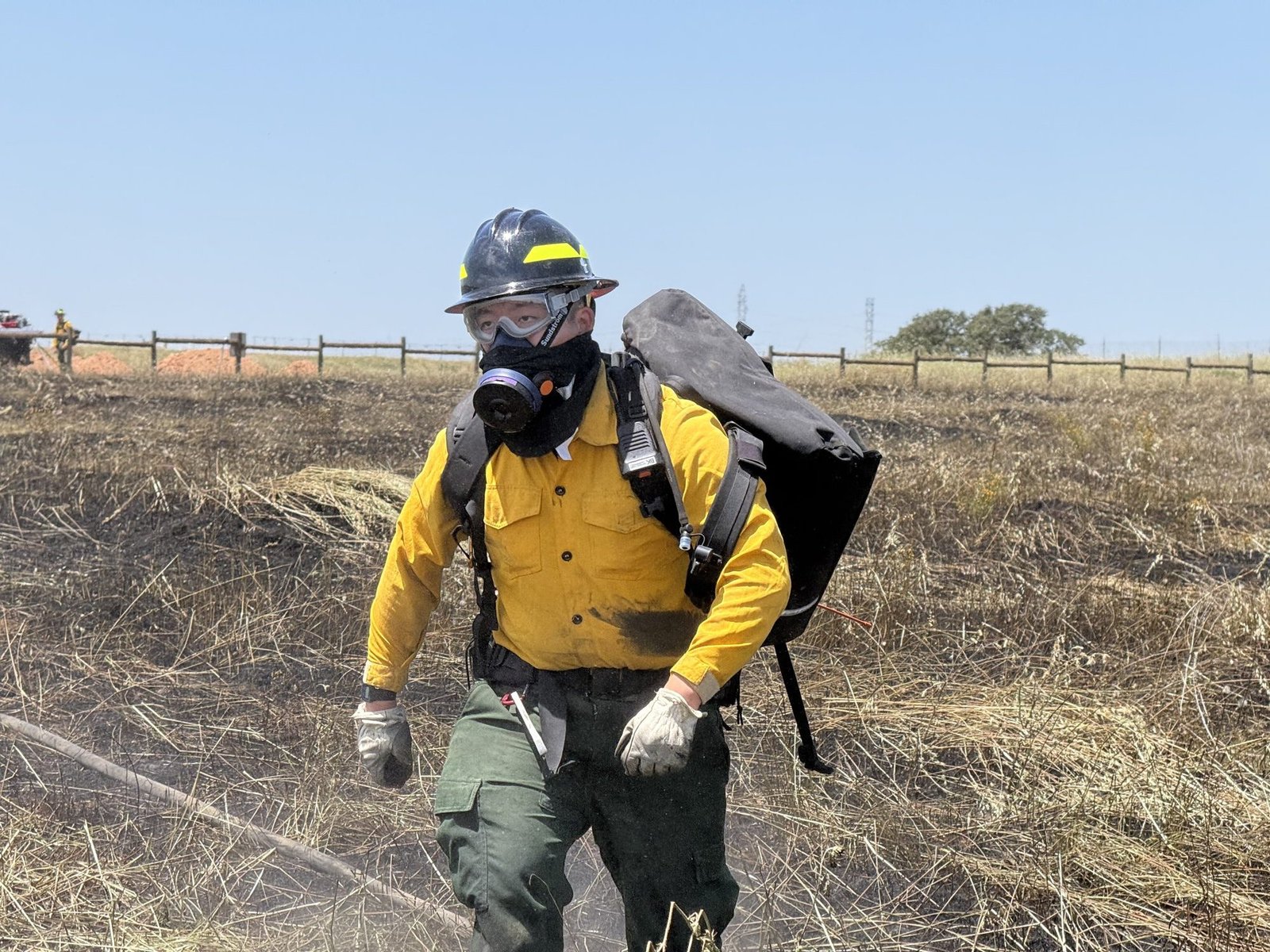
The same kit wildland crews carry
Sundström designed this kit for wildland first responders working in smoke, ash and embers. The spark arrester and pre-filters that protect a crew member’s filters on the line also help when you’re raking ash out of a flower bed.
Running a crew, department or HOA program? See our professional guide.
Filters and care
When to change filters, and how to keep your mask ready
Pre-filter: change first
When breathing starts to feel harder, swap the thin SR 221 pre-filter. It catches coarse ash so your P100 lasts longer. It is not a filter on its own, so never use it without the SR 510.
P100 filter: when breathing stays hard
If breathing is still hard after a new pre-filter, replace the SR 510. Also replace it if it is damaged, wet through or visibly dirty. Keep spares from a 5-pack.
Gas cartridge: when you smell or taste it
If you smell or taste chemicals, or feel dizzy or sick, leave for fresh air right away. Then replace the SR 232. An exhausted cartridge can let vapors through without any change in breathing.
Clean
- Wipe down with the SR 5226 cleaning wipe after use
- For heavy soot, take out the filters, wash in warm, mild soapy water (no hotter than 104 °F) with a soft brush, rinse and air-dry
- Never use solvents. They damage the silicone and valves
- Inspect the valves and harness, then do a seal check after you reassemble the mask
Store
- Keep it in its box in a clean, cool, dry place out of direct sunlight
- Write each person’s name on the SR 368 ID tag
- Keep spare filters sealed. Unopened, filters last 10 years and cartridges 5 years
- Don’t store it loose in a hot truck bed or dusty shed
A kit for every household member
Fit every adult and teen in the house
- One mask per person. Masks are fitted to one face, so measure and choose a size for each adult and teen.
- Young children: the EPA notes NIOSH-approved respirators aren’t made in sizes for young children. Keep kids indoors in clean, filtered air, and don’t let them help with ash cleanup.
- Health conditions: if you have heart or lung disease or are pregnant, ask your doctor before wearing a respirator.
- Heat: masks make hard work hotter. Take breaks, drink water, and stop if you feel dizzy or short of breath.
- Spares: for each kit, keep at least one extra SR 510 filter and a supply of pre-filters.

Know the limits
What this mask does not do
- It does not supply oxygen. Never use it where oxygen may be low, or in conditions immediately dangerous to life or health.
- It is not for fighting structure fires and is not a replacement for a firefighter’s SCBA. Do not enter a burning building.
- The P100 filter removes particles, not gases. No filter in this kit protects against carbon monoxide.
- It does not protect your eyes. Add sealed goggles if smoke or ash irritates them.
- The best protection from heavy smoke is getting to clean air. If you have trouble breathing, feel dizzy, or smell smoke inside the mask, leave the area.
FAQ
Common questions
Is a P100 better than an N95 for wildfire smoke?
Both are recommended by the EPA when they fit and seal well. A P100 filter is rated to capture at least 99.97% of particles, compared with 95% for an N95, and it is oil-proof. The SR 100’s silicone mask is reusable, and you replace only the filters.
Do I need the SR 232 gas cartridge for smoke?
Smoke and ash are mainly particles, which the SR 510 P100 filter handles. The SR 232 adds protection against certain organic vapors and acid gases, which is useful when you’re handling household chemicals, solvents or spills during cleanup. It doesn’t protect against carbon monoxide.
How long does a filter last?
It depends on how much smoke and dust it collects. Replace the pre-filter when breathing gets harder. If that doesn’t help, replace the P100. Unopened, SR 510 filters keep for 10 years and SR 232 cartridges for 5 years.
Can my kids wear one?
NIOSH-approved respirators aren’t made in sizes for young children (EPA). Measure older kids and teens the same way and do a seal check. If the S/M won’t seal, keep them indoors in clean, filtered air.
Will it work with a beard?
No. Facial hair where the mask meets your skin breaks the seal. The sealing area needs to be clean-shaven.
Can I wear glasses with it?
Yes. The half mask sits below your eyes. Sundström’s instructions say to take your glasses off while you put the mask on. Then put them back on and redo the seal check.
Can I return a mask?
Unopened kits can be returned within 30 days. For hygiene reasons, opened masks, filters and cartridges can’t be returned. See our return policy.
Is it NIOSH-approved?
Yes. The SR 100 with the SR 510 P100 filter, alone or with the SR 232 cartridge, is NIOSH-approved under 42 CFR Part 84. The approval label is printed in the user manual inside each kit.
Be ready before the smoke rolls in
The Sundström Wildland First Responder Kit costs $75 in S/M, M/L or L/XL. Ships from Thousand Oaks, CA.
Also see: Sundström masks for the home · Professional & agency guide · Wildland mask shop
This guide is general information, not medical or safety advice. Always follow the Sundström user instructions that come in the kit, and local public health guidance.